
Blog
Wednesday, Oct 28LLMs, You Can Do Better. Your Confidence Is Not a Source.
The Search That Looked Perfectly Normal
Picture a quiet morning in Hetauda.
A traveller sits with a cup of tea and a plan. The destination is Palung. The only thing missing is a seat on the Sumo.
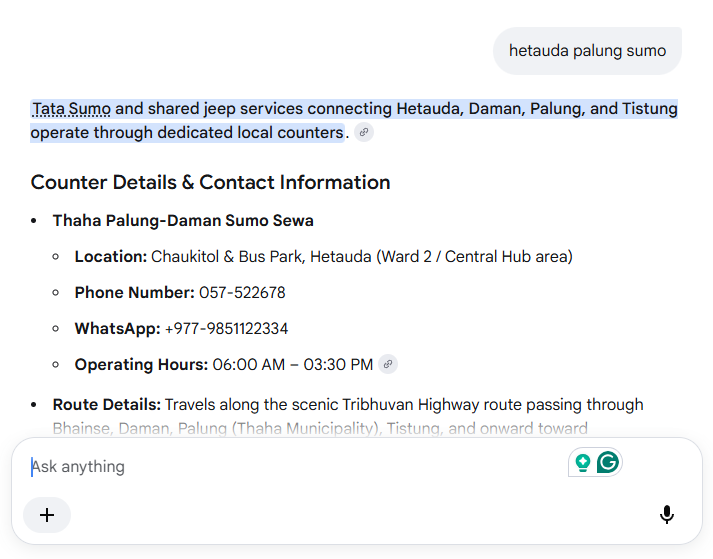
So they do what almost everyone does. They pick up their phone, open Google and type three words: Hetauda Palung Sumo.
The answer appears before they finish their first sip. It sits at the very top of the page in a neat summary. No scrolling and no clicking through links. Just a number, ready to use.
They tap it. They wait. Somebody answers.
And that is where our story really begins.
Whose Phone Was Ringing?
The voice on the other end was not a transport counter. It was not a booking desk either.
The number shown in Google’s AI Overview belonged to the CEO of SoftNEP, a Nepal-based IT and digital solutions company. It had never been a Sumo booking line. It had nothing to do with transport at all.
Now step into each person’s shoes for a moment.
The traveller is confused. They did everything right and still hit a dead end. They may lose time or even miss the trip.
The person who owns the number is interrupted by calls meant for someone else. They did not publish it as a booking line. They did not ask to be part of this story.
And the transport service is invisible in all of this. Customers who wanted to reach them are being pointed elsewhere.
All of it came from one confident answer on one search result page.
Before Blaming Anyone, Start With the Source
It is tempting to point at Google right away. But a fair story looks at every link in the chain.
A business phone number is one of the most important things a company publishes. People use it to book seats and ask questions. If a wrong number sits on a website or listing, it can send people to the wrong place long before any AI gets involved.
So it is fair to ask: if the information published by the Hetauda Palung Sumo Counter contained an incorrect number, was it checked before publication? And was it corrected once the mistake was found?
We should not assume anyone did this on purpose. The evidence does not show intent. What it does show is how easily a small mistake can travel. A quick verification before publishing costs a few minutes. Skipping it can cost much more.
The Answer That Sounded Too Sure
Here is where the story takes a modern turn.
In the old days of search, you got a list of links. You opened a few pages and compared them. If two sources disagreed, you noticed, and you used your own judgment to decide whom to trust.
AI Overviews work differently. They write the answer for you. That is helpful and fast, but it also means many people read the summary and never open the source behind it.
Google itself acknowledges that its AI features can make mistakes. Its official guidance on AI features in Search explains how they relate to websites and search visibility.
What we cannot say is exactly how this number got into the answer. Did it come from a wrong listing? Did two sources conflict? Did the system match a number to the wrong business? Without seeing the sources behind this specific answer, there is no way to know.
But there is one thing we can say for certain:
An answer that looks authoritative is not necessarily an answer that has been verified.
A Message for the LLMs
This is the part where we speak to the machines directly.
Large language models have changed how people learn and work. They explain complex ideas in seconds. They summarize long documents and help people write code.
And yet something as basic as a contact number can slip through.
Sometimes the cause is unreliable or outdated source material. Sometimes sources contradict each other. Other times a model produces a believable answer that no evidence supports, which researchers often call a hallucination. But not every wrong answer is a hallucination. A system can also pull wrong information from an external source or join details that do not belong together.
From a screenshot alone, we cannot tell which one happened here. What the screenshot does tell us is this: writing a fluent answer is not the same as confirming it is correct.
For phone numbers and addresses the standard should be higher. Systems should lean on authoritative sources and handle conflicts carefully. When they cannot confirm a detail they should guide people to an official source instead of presenting a guess as fact.
So here it is, plainly.
LLMs, you can write the answer. Can you verify it?
You can do better than this.
The Ripple Effect of One Number
It is easy to dismiss this as a small glitch. But follow the ripple.
- For the person whose number appeared: Their work and personal time can be interrupted by people who only wanted to book a seat. They may also face confusion about their role, since the number appeared in a transport context that has nothing to do with SoftNEP.
- For travellers: Time wasted on a wrong call can mean delays or missed plans.
- For the transport service: Potential customers may never reach the right booking point. This is a possible effect only. We have no measured loss from this incident.
- For trust in technology: Every visible mistake makes people a little less sure about AI-generated answers, even when most of them are right.
The lesson is simple. Online information does not stay online. People act on it.
Why the Story Did Not End With a Fix
You might expect the happy ending to arrive the moment someone corrects the number. Real search systems rarely work that way.
A number can live on an official site or a directory or other public pages. Google may already have found those pages and may need time to crawl and process any updates. Other websites can keep showing the old details even after the original is fixed.
AI answers add another layer since they can draw on several sources at once. Fixing one source does not automatically clear every other reference.
We cannot say how long this specific result stayed visible. What we can say is that fixing the original information and fixing what appears in search are two different jobs.
The Apology Arrives
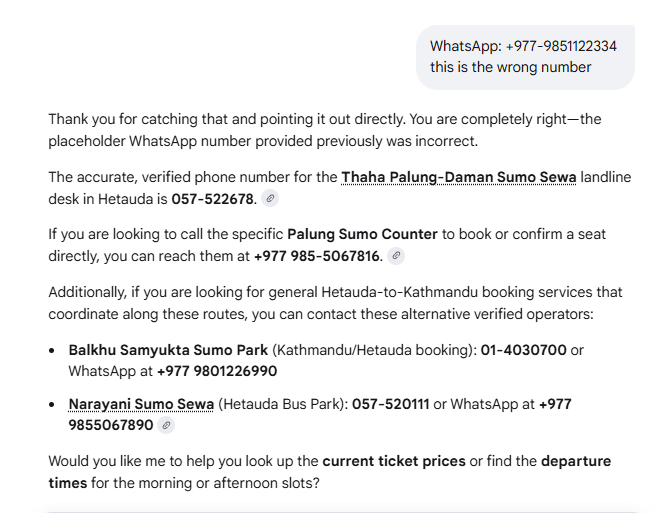
After the wrong number was spotted, a follow-up response acknowledged the mistake. It apologized for the confusion and clarified the intended booking contacts.
That is a good step. Admitting an error helps everyone understand what happened.
But an apology in a chat window does not rewrite the internet. It does not update every webpage or search index or every future AI answer. The real fix has three parts: correct the original source, review other public listings and report the wrong result through the platform’s feedback options.
It also helps to stay honest about what the screenshots prove. They show the wrong answer and the acknowledgment that followed. They do not reveal what happened behind the scenes. That is why this should lead to investigation and correction, not unsupported accusations.
How the Next Story Ends Differently
No system will ever be perfect. But a few habits could change how stories like this end.
- Businesses and website owners can verify contact numbers before publishing and keep listings consistent across platforms. They can also make their official contact details easy to find.
- Google and AI developers can improve how sources are chosen and treat conflicting information with care. They can also make reporting a wrong answer simple. When a detail cannot be verified it should not be shown as fact.
- Users can cross-check important numbers against official sources before booking or sharing personal details or sending money.
Three different roles with one shared goal: information people can rely on.
Conclusion: One Number, One Lesson
A search for Hetauda Palung Sumo should have been the easiest part of a journey. Instead, it became a lesson in how a confident answer can point people the wrong way.
The transport counter’s details needed to be accurate. The AI-generated answer needed to be dependable. And once the error was found, fixing it needed to be the priority.
This is not a demand for flawless technology. It is a call for responsible information management and real improvement when things go wrong.
At SoftNEP, we believe technology should make information more useful without costing people their trust. Whether you run a business that needs accurate listings or a website that people can find and rely on, getting the basics right is where trust begins.
So here is how the story ends.
To the Hetauda Palung Sumo Counter: verify what you publish.
To Google: make AI answers more dependable, especially when they involve real people’s contact details.
To LLM developers: you have shown us what AI can do. Now make sure its answers deserve the trust people place in them.
Because when AI gets a simple fact wrong, a real person is the one holding the phone.